
30 October 2026
Why India's commercial buildings need cooling systems designed for Indian conditions
India's summers are getting hotter
In April 2026, all 50 of the world's hottest cities were in India. In May, India's peak power demand hit a record 270.82
Cooling that must keep up
India's skyline has changed fast. Glass-fronted offices, sprawling malls and modern hospitals now define its commercial landscape, and like commercial buildings anywhere in the world, they depend on consistent, reliable cooling to function.
People shopping in a mall, watching a film, waiting at a clinic or working through a long afternoon at the office all expect the space around them to stay comfortable, whatever the temperature outside. That makes a dependable commercial air conditioning system one of the most important parts of a building's infrastructure.
Heat is only half the brief
Heat is the most visible challenge, but commercial buildings in India face several others that rarely feature in a global spec sheet.
People. A mall on a festive weekend. A hospital OPD at ten in the morning. Every occupant adds to the heat load, and Indian commercial spaces see dense, unpredictable footfall.
Power. Voltage in India is rarely stable. Dips, swings and surges are a regular part of operating life, and equipment designed for a perfectly steady grid can struggle to cope.
Scale. Indian commercial projects are large and complex: multi-block campuses, long floor plates, and mixed-use developments where a food court, a server room and a boardroom are served by one system.
What decision makers must look for
Given the above challenges, consultants, architects and facility heads who must identify the right central air conditioning system for a new project cannot rely on the rated capacity of a system alone. Because that number in isolation tells only a part of the story.
What is the capacity the system can deliver on the hottest afternoon of May… with the building full… and the voltage fluctuating?! That is the rating that truly speaks of a system’s efficacy.
A system that delivers cooling when the ambient is at its highest. With electronics that can withstand an unstable supply and high temperatures. And enough reach to serve a large, complicated floor plan. A system that can cool a packed atrium and an empty meeting room at the same time, efficiently, and without either paying for the other.
That’s the system that will truly deliver desired conditions under all conditions.
In short, what is needed is cooling that is designed for Indian conditions. Inside out.
Why VRF technology suits the best
For commercial buildings that need to handle all the challenges discussed, Variable Refrigerant Flow (VRF) is among the most widely used HVAC solutions, for commercial applications like offices and malls to hospitals and hotels.
A VRF system connects one outdoor unit to multiple indoor units through a network of refrigerant piping. Instead of chilling water and pumping it around the building, it carries refrigerant directly to each indoor unit. The name describes how it works: the system continuously varies how much refrigerant flows to each unit, based on how much cooling that space needs at that moment. A packed conference room draws more; an empty cabin draws less. Meanwhile, an inverter-driven compressor speeds up or slows down to match the building's total demand, so the system runs in step with the actual load instead of cycling on and off at full power.
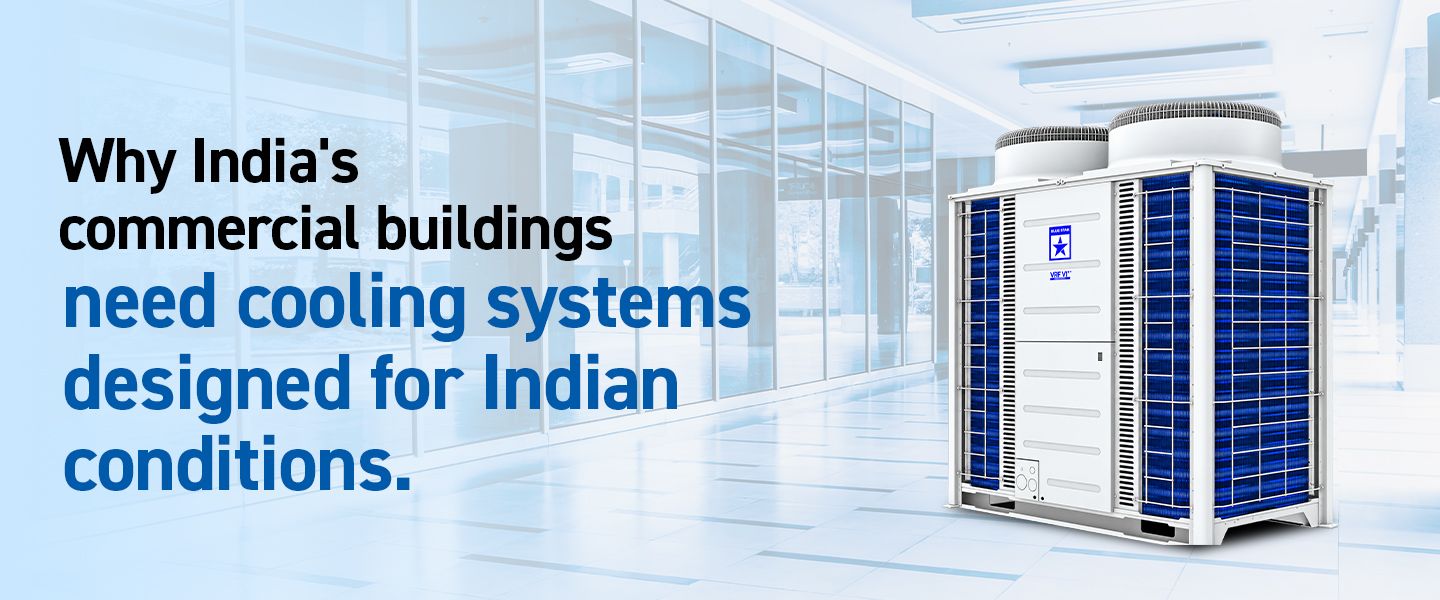
The Blue Star VRF VI Plus
Blue Star has been building cooling solutions in India since 1943. Over the eight decades since, we have learned how much the Indian climate asks of a system, and that experience shapes the way Blue Star HVAC systems are engineered, to tackle local operating conditions efficiently.
The all-new Blue Star VRF VI Plus brings you cutting edge VRF technology along with the benefit of all that experience. While most cooling equipment is rated at standard test conditions of around 35°C outdoors, the Blue Star VRF VI Plus is designed to deliver 100% cooling capacity at 43°, and work non-stop even at 56°C . What’s more, the derating curve does not drop off significantly till about 48oC, so the system delivers practically full capacity up to that temperature. The high-performance inverter compressors used in the VRF VI Plus and the 30% larger surface area of the coils ensure this excellent cooling performance even at such high temperatures, besides enhancing part-load efficiency and ensuring reliable operation.
Being a cutting-edge air conditioning solution, the VRF VI Plus is equipped with a whole range of electronics for precise control of various parameters. Significant amongst these is its built-in Edge AI, which helps improve efficiency in real time and ensures better uptime through smart predictive maintenance, and a wide range of smart controllers that make the VRF VI Plus user-friendly and intelligent. All the electronics is designed to be robust to withstand operation at high ambients through careful design such as cooled PCBs and the use of high-quality industrial grade components.
The Bue Star VRF VI Plus is also designed to operate effectively across a wide 320 to 460 V input voltage range and includes surge protection up to 8kV, thereby handling voltage fluctuations and surges that most Indian buildings face.
For large projects, the 1km-long piping run design of the Blue Star VRF VI Plus allows one system to reach the far corners of commercial complexes. Over 75 indoor unit models, along with centralised, mobile and BMS-integrated control, allow each space to be cooled as per its needs.
Packed with features
Apart from the core design aspects of the Blue Star VRF VI Plus being finely tuned to peak performance even in tough climatic conditions, the system also offers many unique features that make it a sought-after solution.
For instance, a 'Quiet Mode' makes an already low-noise system operate with even lower sound levels; Its 'Flexi capacity setting' allows the operating capacity to be reduced to as low as 25% of rated capacity during low-load periods, saving substantially on power; a wide range of smart controller options ranging from wireless remotes to remote monitoring, hotel key card control and BMS compatibility, allow for great flexibility in operation; and a tenant billing system allows IDU-wise billing in tenanted complexes driven by the same VRF.
Built on trust. Built for Indian summers.
Every Indian summer sets a new benchmark in peak temperatures. And India's commercial buildings will keep raising their expectations from the systems that cool them.
Blue Star has met such expectations over decades, and earned the trust of building owners, consultants and architects, who rely on its engineering expertise.
The VRF VI Plus is Blue Star’s latest innovation that addresses all the demands of Indian commercial complexes. It delivers cooling even when the mercury peaks, it keeps its composure when the power grid does not and allows a single system to reach and control a large network of indoor units across a wide area.
With its 360o reliability, exceptional flexibility, and all-round intelligence, the Blue Star VRF VI Plus is a complete, high-performance, low carbon footprint air conditioning system, designed and manufactured to be perfect for challenging Indian conditions.
If your next project is on the anvil and you are looking for the right solution to tackle oncoming summers, do call 1800 209 1177 (Toll Free) or visit us at www.bluestarindia.com. Our team will be delighted to show you what Blue Star VRF VI Plus can do for you.
Related Blogs

